
“I finally decided I was ready to address my trauma. But then I read an article about how it adversely affects marriages. So, I guess I either live with the trauma… or destroy my marriage?”
I understood my client’s deep concern.
She was right.
But the truth is out.
We all become a version of where we came from.
We express the good, the bad, the ugly.
Realizing that truth is our fork in the road.
One arrow says, “Same”.
The other says, “Change”.
Yes, research does say that marriages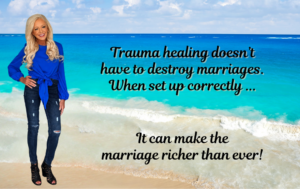
often experience more stress than ever
when one partner enters trauma healing.
But it doesn’t have to be that way.
I’ll try not to go on a rant here … or at least try to make it short.
For the life of me, I don’t understand why…
therapists,
counselors,
coaches,
clergy,
and/or anyone in the helping profession…
would fail to work with both partners to make the process as smooth and rich as possible — instead of trying to clean up marital destruction on the back end.
(End of rant.)
I assured my client that the research wasn’t wrong — but we could do everything possible to set the healing process up for success.
For her individually.
And for her marriage…so it could remain strong
and become closer than ever.
The relief on her face was so visible, it was as if she was breathing again. The first time since she’d read the article.
I gave her a moment to soak it in.
After a deep breath, she asked:
“How would we accomplish that?”
(From my AA friend. “Standing on the edge of change (which is deciding it’s time to) is overwhelming. When you’re used to having answers or pretending like you do, brings every justification that things really aren’t that bad, which is fear making the path of yet more destruction…look inviting. Surrender has no answers but is the door to every answer I’ll ever need to have happen.”)
I smiled and leaned in.
“I’m so glad you asked. I usually have this conversation at the end of the first session — if it looks like we’re moving forward together.”
She nodded.
“I suggest that before we begin your work, we invite your husband in. Together we’ll share what the process will look like … for you, for him, for the marriage. Then we’ll make a plan that ensures as few setbacks as possible.”
The relief was visible in her body and her face.
Let me share how the three of us worked together — enriching the marriage instead of allowing it to deteriorate.
Regardless of how you do your trauma healing —
in a workshop,
with a coach or therapist,
through YouTube videos —
I hope you’ll do what needs to be done,
to keep your marriage connected and solid.
Healing goes quicker and smoother when you do.
Let’s be part of the statistic that creates a stronger marriage through the healing process — instead of the ones who try to clean up the destruction on the back end.
It IS possible.
1. Coaching the Partner in Healing Partnership
Although I introduce the idea of “healing partnership” any time I work with couples, there’s no time more crucial than at the beginning of trauma healing.
What is healing partnership?
Here’s my definition:
“Two people who are fully committed to their relationship, to their own personal growth and development, and to the personal growth and development of their partner. They come alongside one another with a stance of zero negativity and full accountability … committed to noting the impact of their words, behavior, and decisions on the other person and on the relationship. They are present with one another and invest daily in the relationship.”
When my client returned with her husband
and I shared this definition,
his response was not unusual.
“Wow. I’m so glad you’re sharing this.
I would’ve just distanced myself and given her space to heal.
And that would have been the absolute wrong move.”
I assured him that most partners don’t know what to do … which is exactly why I had invited him in.
“I wouldn’t have wanted that to be a problem,” he added. “It just seemed like that’s what she would need.”
I understood his heart. It’s usually the heart of a partner who truly cares.
And yet — without guidance, it’s likely to send the relationship in the wrong direction.
Here’s what I say to each partner when they’re embarking on trauma healing.
To the one in healing:
- Be very aware of what you need — and ask for it clearly. (In all my years of marriage counseling, I’ve yet to meet a spouse who passed Mind Reading 101.)
- Share what feels safe to share about your healing process. If you’re not ready to share, simply ask for time … and assure your partner it’s not about them.
- Notice your fluctuations in self-regulation. Have 3 things you do that helps you regulate. Share those with your partner so they can gently suggest them in moments of dysregulation.
- Make daily efforts to show love to your partner … even when you don’t feel like it. That’s your investment in keeping the relationship a priority.
- Allow your partner to love you. Even when you don’t feel like it. So many partners who have a loved one in trauma healing refer to Little Big Town’s song lyric: “You push my love away like it’s some kind of loaded gun.” Don’t do that.
To the partner:
- Ask about their process with sensitivity. If they choose to share — put down your phone. Turn off the TV. Close the laptop. Set aside whatever project you’re working on.
- Listen with your heart. Reflect (summarize what you’re hearing). Validate (“It makes sense to me…”). Empathize (“You must feel…”). Be available as long as they want to share. When it’s enough, let it rest.
- Show extra love. Bring them a hot towel when they exit the shower. Give extra-long hugs. Do random acts of kindness. Put fuel in their car, pick up the dry cleaning.
- Leave other issues for a later time. Make note if needed … but keep their nervous system as supported as possible.
- Ask what they need. And deliver whenever possible.
Be healing partners to one another.
2. Learning to Communicate Differently While Healing
“Oh my goodness — that list is a lot. All good, but a lot. I hope I can remember it all. Maybe the fact that all of this is missing is what sent her into trauma healing in the first place.”
I loved the husband’s sensitivity … his true awareness and authenticity
about his presence in the marriage.
This is true of most couples I work with, whether it’s the husband or the wife.
My admired colleagues, the Gottman’s, found in their research that most couples communicate an average of 36 minutes a week. And most of that is logistics.
STOP … take that in. The Gottman’s are the foremost authorities in the world on marriage relationships (google them) they KNOW of what they speak … if we can’t do anything else … we CAN “up” our communication time!
My opinion about 36 minutes a week?
That’s a crying shame.
But if we can correct that in this preparation process — what a gift.
“It’s not too difficult,” I said. “Just two things to remember:
· Practice TREKy talk — Tell the Truth with Respect, Empathy, and Kindness. Be very intentional about it.
- Spend 20 minutes of undistracted time daily checking in on each other and the marriage. Share gratitude’s from the past 24 hours. Ask what you might do differently to contribute goodness into the marriage.”
“I can do that,” he said.
Then, catching my expression: He quickly repented and said, “I WILL do that.”
The wife agreed.
That’s all it takes to set your marriage up for closeness … and to prevent any adverse effect from the healing work.
3. Do Your Healing at the Same Time
“So — I’m committed to all of that,” the husband said then asked,
“Is there anything else?”
I’m sure he wished he hadn’t asked.
“One thing I do like to say is this. If you have any unresolved trauma of your own, I like to suggest that both of you do your healing work at the same time.”
“Uhhhh…”
I knew what was coming next. So, I jumped in.
“Let me give you my definition of trauma for you:”
“Any experience that has affected us in any way that diminishes who we are … or all we were created to be … dulling our gifts and talents and making life more difficult than it would have otherwise been.”
His expression of deep contemplation, and his silence, actually answered the question.
“Well… mine wasn’t as bad as hers…”
I said gently: “It’s not a competition. Unresolved trauma affects relationships. And the sooner both of you resolve your trauma, the sooner you can move forward with a fulfilled life together.”
A word to my readers here:
Sometimes the trauma comes from the relationship itself.
Hurtful words.
Dishonesty.
Addiction.
Betrayal.
All these carry traumatizing power.
When that’s the case, it’s absolutely crucial that both partners enter trauma healing.
When one heals and the other doesn’t —
or when repair work is needed and left undone —
the relationship is at great risk of falling apart.
Both need to heal.
Usually, the one who’s been injured is the first to reach for help.
But the truth is that they both need help.Trauma begets trauma.
Partners don’t traumatize because they’re bad people.
They traumatize because their trauma is unresolved.
(And often, what feels “normal” to them feels “traumatic” to their partner.)
There’s nothing unredeemable — IF both partners are willing to heal.
In the case of the couple I’ve been describing,
they both devoted themselves to trauma healing.
Imperfectly, but intentionally, they followed the guidelines I gave them for enriching the marriage while healing.
It’s such a beautiful thing to witness a couple so devoted to their healing — and to being healing partners to one another.
Trauma healing does not have to diminish a marriage.
When done in the right way, it can result in deeper connection, richer intimacy, and a brighter future.
*****
“I never dreamed that an article that scared me to death about the future of our marriage would end with both of us healing at the same time.”
My client said that to me during the final days of her work with me.
But what her husband said was even more remarkable.
“I knew the way my dad treated my mom hurt her terribly. Probably damaged her. Probably sent her to an early grave.
But in looking at what he did to her … to all of us … I truly had NO IDEA I was doing the same thing to my wife. No wonder her trauma popped up.
Thank you for helping me see myself accurately, without toxic shame. For assuring me that’s not who I truly am. And for holding space for me to break those patterns — and become all I was created to be.”
He indeed saw how he was repeating his unresolved trauma.
His courage to look at his patterns … and make the changes … was remarkable.
Their marriage became living evidence that trauma healing doesn’t have to destroy marriages. Done well, it has the power to heal and enrich them.
That’s my hope for you.
For your healing.
For your healing partnership with the one you love.
An Invitation
If you’re navigating this question in your own life — “Can I heal without losing my marriage?” — I want you to know: it is possible.
With guidance, intention, and both people willing, healing can bring you closer rather than pull you apart.
I’m putting together a small 6-week healing group for trauma survivors who want to do this healing work for themselves — with support, structure, and community.
Twelve spots. Waitlist gets first access.
Click here to join the waitlist: https://bit.ly/DrNeeciesHealingWorkshop
With Love & “Healing Partnership” Hugs,
Dr. Neecie