
“You’ve shared the importance of raising my standards. But it’s SO HARD when the people I spend time with are comfortable with mediocrity and settling for the next irresponsible choice in front of them.”
I sat with that for a moment.
Because?
He wasn’t wrong.
He wasn’t being negative or unkind.
He was telling the truth.
The kind of truth most people,
whisper to themselves,
inside their head,
in quiet moments privately ruminating internally …
“The people around me are not where I want to be.
And I don’t know what to do about it.”
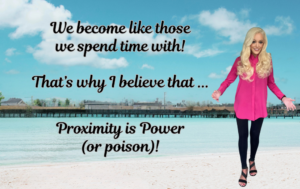 I’ve believed something for a long time.
Long before it became a popular phrase in personal growth circles:
Proximity is power.
The people you spend the most time with shape …
your choices,
your decisions,
your emotions,
your health, even your long-term sense of what’s possible.
This isn’t just a feeling.
It’s a meaningful finding.
As an ancient Proverb declares …“The one who walks with wise people will be wise, but the companion of fools will suffer harm.”
Studies at Harvard show that habits are contagious inside our social networks …
smoking,
drinking,
exercise,
all of it.
We pick up the rhythms of the people we’re closest to, often without realizing it.
Sometimes for our improvement. Sometimes leading to the demise of
our ethics, standards, and identity.
Other research shows that students surrounded by high achievers tend to raise their own grades. Employees surrounded by high performers tend to elevate their own performance.
It’s never too late to choose your influencers.
Most people (if not all) can create their own environments.
And environments create our world view.
And our world view creates our state.
And our state determines our destiny.
Income levels, too, cluster within social networks at strikingly similar tiers.
The moral of the story isn’t subtle: be very aware, very careful, and very intentional about who you spend your time with.
This is especially true after trauma.
After we’ve been hurt, we tend to seek out people who’ve been hurt too.
It feels safer.
It feels like we’ll finally be understood.
And there’s truth in that …
there’s real medicine in being with people who have walked your road.
But there’s a hidden cost.
If the people around you are stuck in the endless healing loop … processing without progressing,
understanding without moving …
their love of gravity, will pull on your dreams of flying.
You’ll feel safe.
You’ll feel understood.
But … you’ll stay stuck.
The people who can hold both:
I’ve walked through trauma
and
I’m building a life that’s moving forward …
are the ones whose proximity changes you for your good.
What I shared with my client moved him so deeply that I want to share it with you, in 3 steps.
1. Honestly assess who you spend your time with.
I asked my client to make a list of
the 10 people he spent the most time with.
Not who he wished he’d spent time with.
Not who he loved most.
But who he actually … spent the hours of his week with.
Then I walked him through an exercise that’s become well-known in personal growth circles.
I want to introduce it carefully, because it can feel uncomfortable.
This isn’t about income.
It’s about patterns.
But income is one of the most visible patterns we have, which is why it’s a useful starting point.
Guess each person’s income.
Calculate the average.
Then ask yourself: Is that where I want to be?
There’s no specific science guaranteeing the result, but a 2022 study published in Nature — analyzing data from 72 million Americans — found that “economic connectedness” (the extent to which lower-income individuals have friendships with higher-income individuals) is one of the strongest predictors of upward mobility.
The income piece is just the visible layer. The real exercise is deeper:
- Where are these people in their own personal growth?
- Where are they in giving back?
- In paying it forward?
- How are they contributing to others?
- How are they making a difference in the world?
The people who score high on these questions — those are the ones whose proximity will change you. For the good. For your best!
If you feel uncertain or fearful of this kind of change, you’re normal … so lean into that.
Then walk into your new environments and trust this … if you want to make a friend let them do something for you.
Creating a new sense of trust, is the beginning of allowing your change of environment, the progressive influence that’s guaranteed, by each step you take, in changing your environment.
When you reach outside the healing loop, using all those new truths about yourself, the environment you long for will present open doors.
Ultimately, it’s up to you/me/us to walk through these open doors and into an environment that builds on the truths we now know about ourselves.
2. Commit to adjustments that would change your life.
I shared with my client that early in my own healing — long before trauma was a word used for anyone other than veterans — I realized something hard:
I was spending almost all my time with people in deep crisis.
People in the dark night of their souls.
Clients, patients, people I was responsible for.
I didn’t want to stop that work. It was my calling.
But I knew that if I didn’t get intentional about who I spent my non-clinical hours with, I was going to burn out like a crispy critter.
(I was in my late 20s. I thought I was invincible. I wasn’t.)
I was building a bridge in 5pm Los Angeles traffic … creating the trauma healing process for myself.
Testing it in my life.
All while simultaneously running …
treatment centers,
a private practice,
and workshops.
Pouring out what I was figuring out in real time.
I needed people around me who weren’t drowning.
So, I made a commitment.
Not a thought.
Not a wish.
A commitment.
What about you?
What are you committed to do?
Trust is the door to every freedom.
And yes, it’s a scary thing to go solo.
But trusting your heart with uncertainty, is the only way that certainty will find you/me/us. And the only way that our healing can find the courage to discover an environment where we can thrive!
When we trust … we change! Now commit to it!
3. Make the plan. And execute it.
Yes … think about it.
Pray about it.
Journal about it.
But thinking without action is like faith without works … both are dead.
Shortly after my commitment, I signed up for a training at The Meadows in Wickenburg, Arizona.
While there, I met a seasoned psychologist from Dallas (my area), and I asked her how she’d built a circle of people who supported one another … professionally and personally.
She paused.
Then with a gentle smile, confessed she hadn’t.
But knew she needed to.
We made an agreement on the spot.
When we got home, each of us would invite 10 women in the helping profession to lunch, to share the idea with them.
Fifteen came. Six stayed.
We met weekly for 20 years.
We took trips together.
We did life together.
We called ourselves the fristers …
more than friends,
not quite sisters.
We lost some.
Some retired.
But we’re still connected, deeply, all these years later.
What could you create?
Remember: it’s not always about removing people from your life.
Sometimes it’s about less time with some, more with others, and adding new rooms you walk into … where the people there carry the quality of life you’re reaching for.
*****
In this past season of my life, I walked through the valley of the shadow of death that we call trauma — again.
Along with healing, I had to recreate where and with whom, I was spending my time.
But I’m back.
Stronger than ever.
Carrying more of myself than I have in a long time.
And it’s part of what’s led me to relaunch C-SPA — the Coaches’ Summit of Partnership & Accountability.
A place where people who refuse to live ordinary lives gather.
Where they bring …
their wisdom,
their knowledge,
their hearts,
their contribution.
Where the proximity itself does some of the work.
Proximity is power.
And in that room, people will thrive.
They will grow.
They will contribute.
They will give back.
They will leave a legacy.
If you’re a graduate of my training and you want to come into that room with me — doors open Tuesday, May 27.
I’ll share more this weekend.
For now, here’s the question to sit with:
Who are the 10 people you spend the most time with —
and are they helping you become all you were created to be?
If not … get intentional!
Change it!
Because you will change them and they will change you!
Faith creates faith and that trust creates the courage to change our environment.
With Love, Dr. Neecie