
“Why has it been so hard for me to love?
I had no idea it wasn’t some kind of loaded gun …
That I was pushing away …
Or that it could be such a wonderful thing!” my client confessed after he and his wife had practiced all week.
If you missed the healing exercise from last week,
I’d strongly suggest that you go back and use it.
It’s short.
It’s simple.
It’s very healing!
Love was designed to be
the most natural
and wondrous experience
a person can have.
A dance of care,
closeness,
connection,
compassion,
concern.
We choose who we love
(unbeknownst to us)
to help fill in the blanks
where we lost the wonder for living.
Yet for far too many people,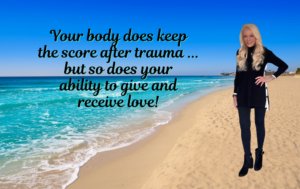
love feels unpredictable or unsafe.
The problem isn’t usually the partner or the relationship itself.
Far too often it’s the invisible (but heavy) result of unresolved trauma.
Let me remind you
that trauma is no small thing.
It programs and shapes the way we
connect,
communicate,
trust. (Or not) …
Trauma programs our nervous system to expect
threat,
danger,
and/or rejection with ANY level of closeness.
As a result,
even when sincere love is freely offered,
it can feel like “some sort of loaded gun.”
Instead of bonding with the one offering pure love, we end up …
shutting down,
controlling,
pleasing,
or pulling away.
In our relationships, these old survival reflexes
become painful cycles to our partners and spouses.
Just remember … your unhealed stuff
has programmed their responses.
I see it almost daily.
One partner pursuing closeness.
The other withdraws.
Because the one withdrawing cannot see it …
What is one of the most common responses
when is the challenge addressed?
“You just misunderstand me.”
OR … “I feel so misunderstood …
Leaving the partner offering their love
feeling confused,
alone,
dissatisfied.
The answer is rarely found in “moving on”
(unless of course … abuse is involved).
Research has repeatedly shown
that unresolved trauma
doesn’t just remain in the past —
it lives on in our bodies, our beliefs, our behaviors.
It affects everything about connection:
- How we give love (or not)
- How we receive love (or not)
- What we believe love is (or is not)
- What we believe love requires.
“I don’t even know how we survived years of this,” my client mused.
I could see he was processing, so I waited.
“I’m just glad she didn’t leave.
I gave her crumbs for years
and told her she was ‘needy’
if she didn’t act like I had given her the world,”
he whispered in shame.
As I say many times weekly to husbands and wives:
“She saw what was in you and caught
enough glimpses of it to stay in the fight.”
Whether it’s the husband or the wife staying with little to hold on to …
they are so grateful when they see the turn around.
(Turn arounds start with resolve and takes hold with consistency!)
Let’s continue the journey together
of reprogramming the way, we love (or don’t) after trauma.
Love is a many splendored thing … great song too!
- The Hidden Weight of Trauma in Relationships
Trauma seldom introduces itself on a first date.
It shows up months or years later.
When empty says to another empty “I need a refill.”
Its effects are both profound
and measurable according to research
You may wonder why I share the research.
First of all, so that you don’t feel alone.
But secondly … to awaken you from your hypnotic state that trauma leaves you in … thinking it’s not that big of a deal.
(Remember, 95% of our conscious thoughts
Are generated by our subconscious thoughts.)
- According to the National Council for Mental Wellbeing (2023), more than 70% of adults in the United States have experienced at least one traumatic event. Those experiences range from neglect and betrayal to violence or loss — all of which shape emotional patterns in adulthood.
- The American Association for Marriage and Family Therapy of which I’m a member reported (AAMFT, 2021) that 72% of couples entering therapy disclose that one or both partners have unresolved trauma influencing their conflicts.
- The Gottman Institute (2022) identified emotional disconnection — often rooted in unhealed trauma — as a core factor in 58% of divorces.
- A University of Alberta (2019) study found that partners with childhood trauma were 60% more likely to exhibit emotional avoidance and 80% more likely to report sexual dissatisfaction.
- The Journal of Couple & Relationship Therapy (2020) reported that studies showed that trauma-related symptoms such as hypervigilance and emotional numbing double the likelihood of serious relationship breakdowns.
It is a REAL thing that trauma affects our programming around giving and receiving love.
Let’s review again why trauma leaves us equating love with danger.
When someone carries unhealed trauma,
intimacy can trigger the very sensations
that were unbearable the moment the trauma happened.
That includes things like …
connection,
vulnerability,
dependency,
exposure.
Even when a partner is gentle,
the other’s body may
misinterpret closeness as danger.
In neuroscience, we call this the approach–avoidance conflict.
It’s when our heart wants connection,
but our bodies brace for impact (danger).
For example, in the beginning of the healing exercises with my couple, he would say, “I love the idea of her just holding me and putting her head on my chest. But the moment she lays it there … I feel this need to go do something … like mow the lawn. How bizarre!”
“Can you imagine her emotional whiplash?” I asked him.
It was a turning point for him to see things from her perspective.
It’s not unusual that neither partner recognizes this as a trauma response.
But it sets off a dysfunctional pattern on autoloop:
- One person reaches out for reassurance or closeness.
- The other withdraws suddenly.
- The one who reached out feels hurt and rejected.
- Then likely questions or seeks answers for the lack of closeness.
- The partner doing the avoidance shuts down even more.
- Both feel like the other is the problem.
- The cycle continues.
The sad truth is that their unhealed pasts are running the show.
Healthy love requires safety, and trauma quietly rewrites its definition.
For most if not all…
That definition is usually something like:
“Love or connection is dangerous …
and should be avoided if you want to survive.”
Without intervention and healing, the autoloop pattern continues …
until it wears the relationship to ashes … or explodes like a forest fire.
The saddest part is that it’s all avoidable …
and can be turned into a warm fireplace with some healing exercises.
My hope and prayer for you,
if you see your relationship in this auto loop, is that will not just read this.
But DO the healing exercises together.
- Great healing begins with acknowledging your partner and owning your part.
Healing relational trauma is not about finding fault.
Many couples show up hoping for me to referee who’s been the problem
or caused the most damage to the relationship.
I don’t wear a black and white striped shirt.
I have no interest in quibbling over things that do nothing for healing.
I’m all about assisting couples in gaining awareness and taking responsibility.
Every couple in the world has experienced moments
when old pain hijacks the present moment.
(It’s all about “right now” … this moment! And chossing a healthy “right now” is all that matters. Say to your past: ‘”There’s nothing you can do here right now.” Say to your future: “All I have is now and I’m ok right now”.)
The difference between rich relationships and those that crumble isn’t the absence of conflict.
It’s whether, both partners can recognize and own the patterns
in the relationship and own their part in it.
One of the longest studies on human relationships was conducted at Harvard.
The results offer profound information for couples:
- Emotional attunement (the ability to understand and soothe each other during stress) is the single strongest predictor of lifelong happiness.
- Couples who practice active repair after conflict live longer and report higher wellbeing … regardless of income or status.
- In couples where at least one partner takes ownership of their emotional triggers, relationship satisfaction increases by an average of 34%.
In another study reported in the Journal of Marital and Family Therapy
it was found that when both partners acknowledged moments where their reactions stemmed from past wounds, communication breakdowns decrease by 49%.
Not only that …
but feelings of emotional safety doubled.
All as a result … of owning their part … and the origins of their triggers.
Don’t make this harder than it needs to be.
My couple asked me: “How on earth do you make this work?
I mean … turn research into hurt feelings at our dinner table.”
I loved that … and accepted the challenge.
I hope you’ll take in the simplicity of this.
Yes, it requires emotional maturity.
But you don’t need a PhD in Emotional Mastery to do this.
Just a determination to pause and do the right thing.
When life is a knot, overwhelm is normal.
Peace is waiting inside every pause.
I gave them this instruction.
When you feel those old familiar feelings and find yourself thinking something like: ‘Here we go again …’ Do this instead:
- Press pause
- Take in a deep breath
- Tell yourself that you can take the lead and take this moment in a different direction
- Say something like: ‘I don’t like how I’m showing up right now.”
- “Surely it’s not me … so it must be something old!”
- Then own your old cycle: “Usually at moment like this, I ______ (ex: get my feelings hurt and say negative things.”
- Ask for help: “I’d like to do it differently, can you help me _________ (ex: by going for a walk with me? Or practicing 3 minutes of gratitude with me?)”
Trauma is nurtured and grows in secrecy and projected focus.
But it heals … in honest visibility.
This is the beginning of “repair” …. which is not done often enough
in these dysfunctional relationship patterns.
Drs. John & Julie Gottman’s research shows that in stable marriages,
partners make a repair attempt (a gentle word, apology, or acknowledgment) within 5 minutes of conflict 86% of the time.
Not the next day.
Not later … when you feel like it.
But within 5 minutes.
In struggling relationships, these repair attempts drop below 20%.
A study done by the American Psychological Association in 2020 found that couples who identify emotional triggers during disagreements resolve issues 44% faster and retain greater relationship satisfaction afterward.
I told my couple that when they were triggered … just say so!
Then say out loud, “I can do better than this … can I have a do-over?”
Repair is not about perfection — it’s about practicing mutual accountability.
An apology that includes ownership (“I see how my fear made me withdraw”) carries far more healing power than one that simply says I’m sorry.
When love meets ownership, shame turns into trust.
-It takes humility.
-It takes courage.
-It takes guts.
But that’s the BEST part of you …
and I KNOW that’s who you desire to be!
Pride destroys.
Humility builds.
- Another healing exercise for couples.
Let’s rebuild some safety together!
Even after awareness and ownership, healing must be experienced,
not just discussed.
You can’t think your way into safety …
no matter how brilliant you are!
You must reprogram yourself into safety.
To do that … you must feel safe.
(Strange as it may seem … ego feels safebut inward driven ego is just that … it’s all about me/you/us … ego focused outward serves the best interest of the present … for all.)
In this exercise, you can reset your emotional connection and rewire habitual trauma responses into patterns of presence, empathy, and co‑regulation.
It rewires both partners as to what “calm” and “close” can feel like together.
Here is the exercise:
- Agree on these safety rules
“We’re here to connect, not to blame or fix.”
“We’ll go slowly and pause if it feels too intense.”
“All emotions are welcome. none are right. None are wrong.”
Choose a quiet, private space.
No distractions.
Sit facing each other, feet flat on ground.
Close your eyes …
Take several slow, deep breaths together.
Inhaling through your nose, exhaling through your mouth.
Look into one another’s eyes and say this to the other out loud 3 times:
“We are on the same team.”
This sends cues of safety to both of your nervous systems.
(I can just hear you saying … seriously!?
My response?
How’s life working doing it the safe way?
Your way? You’ve nothing to lose/everything to gain.)
- Begin with a check In
Take turns asking and answering 2 questions
while the other simply listens (maintaining eye contact).
“What sensations do you notice in your body right now?”
“What emotion do you feel as we sit together?”
This step replaces assumption with awareness.
(Assumptions comes from the amygdala,
awareness comes from the prefrontal cortex).
This naturally quiets the amygdala’s alarm system.
- Share your “body’s story”
Now, one partner shares by finishing this sentence:
(using ‘I’ statements only):
“When we argue or disagree, the story my body tells me is ________”
(ex: I’m not safe, I’ll be left, I must protect myself, I don’t matter).
The “story” is the old trauma narrative —.
Saying it aloud brings compassion into what used to be automatic.
The listening partner’s job is not to fix
or defend … but simply to listen and empathize.
- Learn to empathize
The partner speaks from the heart, using these stem sentences:
Reflect: “I hear that when we argue, disagree, or disconnect, your body tells you ______________. (fill in the story they just shared).”
Validate: “It makes sense to me that your story could trigger a need for you to protect yourself.”
Empathy and gratitude: “At those moments you must feel _______ (ex: scared, worthless, unsafe).”
Guess three feelings … It’s okay of you are wrong.)
Then add: “I’m grateful you shared this with me.
Hopefully it will help me understand you more.”
This combo of …
Reflecting,
validating,
empathizing,
expressing gratitude … dismantles defensiveness
By the way, according to the Journal of Marital and Family Therapy (2021), couples who practiced structured empathy exchanges twice weekly reported:
- 42% increase in perceived safety
- 50% improvement in communication satisfaction over six weeks.
Now switch roles and repeat the last two bullet point steps.
- Make touch safe again.
If both agree, add gentle physical connection —
holding hands,
a hand on the heart,
or shoulder to shoulder.
Breathe together again.
Match the rhythm of your inhales and exhales.
You are retraining your bodies to experience contact as soothing
rather than threatening.
(Time to get real, get honest, you are out of touch with each other.
Rather than throw the towel, change your defense to offense! DO something you’ve never tried!)
Research inspired by Stephen Porges’s Polyvagal Theory (2011)
shows that synchronized breathing and safe touch
promote ventral vagal activation,
leading to relaxation and enhanced trust.
- Close the new healthy loop
End by each of you asking and answering these two sentences aloud:
“One thing I understand better about you now is…”
“One way I want to support our healing going forward is…”
Share 3 minutes of silence,
making eye contact.
Seal the moment however feels natural:
a lingering hug,
a shared deep breath in and out,
or sitting quietly hand in hand for 1 minute.
Oxytocin released through safe touch or mutual stillness. This helps consolidate emotional repair.
Often, this sounds so simple that couples resist doing it.
IT WORKS!
JUST DO IT!
For inquisitive minds, here’s how it works:
- It gives both partners an embodied experience of safety.
- This is the only thing that can override trauma’s programming.
- It signals to the body that closeness no longer equals threat or danger.
- It rewires reactive patterns into compassionate understanding.
- It introduces a new relational memory: we can stay connected even when we’re vulnerable.
A 2020 meta‑analysis in Frontiers in Psychology found that couples who practiced this kind of co‑regulation and empathic repair exercises experienced a 57% reduction in relational distress within 8 to 10 sessions.
Try this exercise weekly or after emotionally charged interactions.
Keep sessions under 25 minutes initially.
Over time, the body learns that repair is possible —
that love doesn’t disappear when things get hard.
That love actually expands through care and presence.
When safety is experienced,
seen,
heard,
felt,
the nervous system begins to associate love with calm instead of fear.
From that foundation, genuine intimacy returns.
*****
Let yourself return to when you both wanted to win each other’s heart.
Yes, you can love well and beautifully after trauma.
Love cannot be fully given or received
when the heart is guarded by survival.
Trauma wired our bodies and heart to be on guard —
not to relax.
Healing invites us to unlearn that vigilance.
When trauma says, “Get ready to protect yourself ….”
Healing says, “You can experience love and still be safe.”
The couples who mend after deep rupture aren’t those who avoid pain.
Or sweep it under the rug that they trip on regularly.
Those who mend are the ones who face it with open eyes, minds, and hearts.
While learning to co‑regulate instead of criticizing.
To listen instead of defending.
To anchor safety by small, repeated acts of presence.
Love doesn’t erase trauma — but it can rewire the body’s memory of love.
Through awareness, ownership, and shared healing exercises.
Then the autoloop of reenacting survival patterns is replaced by a flowing,
reciprocal fountain of love and connection.
Welcome to true love.
Your fertile ground for growth in all areas of your life!
“Love always …
Protects
Trusts
Hopes
Perseveres.”
Paul an Apostle